
Archive for the 'semanticweb' Category

FOAF.Vix - the way to visualise your FOAF file

Icon for the FOAF (Friend of a Friend) project. The colors don't match exactly with the icon presented in the official site of the project.Image via Wikipedia

If you use Friend of a Friend (FOAF) files to describe your profile and want to provide it to the reader in a readable way FOAF.Vix is a perfect service. Let me cite the description created by its authors:

FOAF.Vix is a visualizer and relation explorer for FOAF (Friend of a Friend) files. Although this file format is designed first of all to be machine readable, it is often desirable to be able to browse it as if it were a usual Web page. FOAF.Vix gives you this possibility, presenting the data from a FOAF file in an easy to understand form and allowing to follow links to other Web resources it contains, including links to other FOAF pages, thereby allowing you to explore the network of human relations.

Of course I decided tp use that tool :) So have a look at my readable FOAF profile

Share and Enjoy: These icons link to social bookmarking sites where readers can share and discover new web pages.
  • del.icio.us
  • Digg
  • Technorati
  • Reddit
  • StumbleUpon
  • DotNetKicks
  • Wykop
  • Gwar
  • e-mail

eLearning with semantics

I want to present a short video of my boss,Bill McDaniel, talking about eLearning powered with semantics and what we do in the DERI eLearning cluster.

Share and Enjoy: These icons link to social bookmarking sites where readers can share and discover new web pages.
  • del.icio.us
  • Digg
  • Technorati
  • Reddit
  • StumbleUpon
  • DotNetKicks
  • Wykop
  • Gwar
  • e-mail

Summary of our work in DERI

In less than two weeks I’ living DERI. I’m going back home in Poland. Amogn others, I’ll defend my Master’s Thesis.

Before leaving, we (myself, Filip Czaja and Władysław Bultrowicz) are supposed to present the result of our work. We gave the presentation today.

First, Filip introduced ourselves and showed the context of our work:
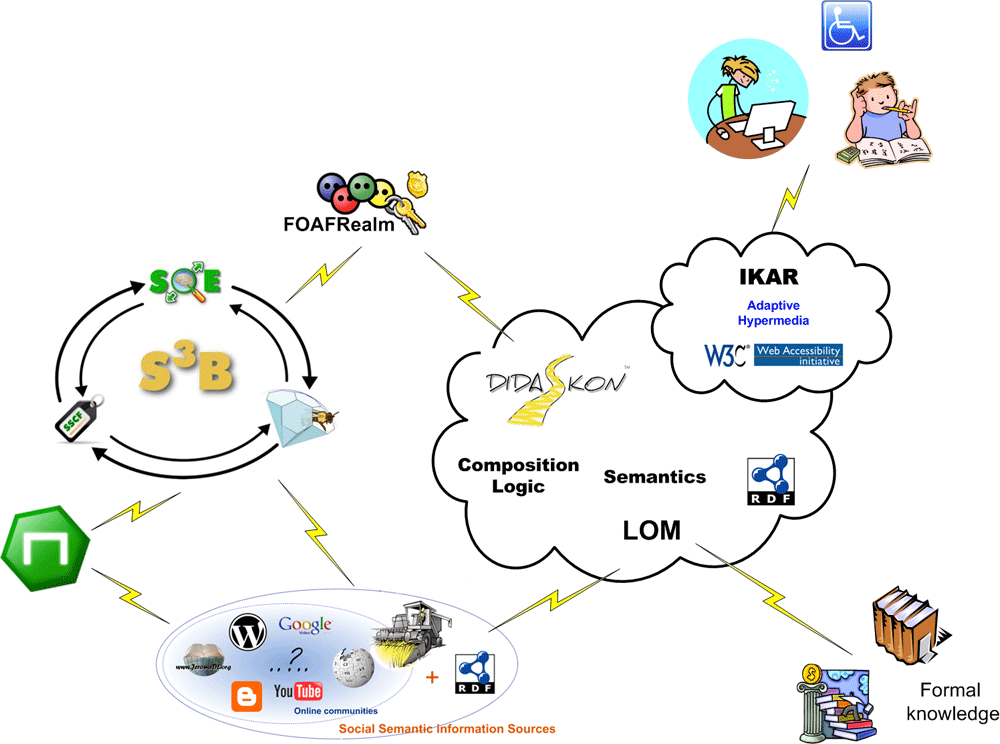
Continue reading ‘Summary of our work in DERI’

Share and Enjoy: These icons link to social bookmarking sites where readers can share and discover new web pages.
  • del.icio.us
  • Digg
  • Technorati
  • Reddit
  • StumbleUpon
  • DotNetKicks
  • Wykop
  • Gwar
  • e-mail

Submission for ISWC ‘07

Today we submitted yet another article; this time for The 6th International Semantic Web Conference (ISWC ‘07) that will take place in Busan, Korea, from November 11 to 15 (Thursday), 2007. I was the main author of the paper; i wrote it together with Sebastian R. Kruk, Tadhg Nagle, Edward Curry, and Adam Gzella. Its title is “IKHarvester - Informal eLearning with Semantic Web Harvesting”.

There is the abstract of the article:

Only recently, researchers and practitioners alike have begun to fully understand the potential of eLearning and have concentrated on new tools and technologies for creating, capturing and distributing knowledge. Focusing on the area of informal learning, this paper describes this emerging domain and assesses current semantic and Web 2.0 tools used in this field. Contributing to the body of research, the limitations of both sets of technologies are documented highlighting areas of definite improvement. Finally, semantic web harvesting technology as a solution is explored in the form of the IKHarvester tool.

There’s the direct link to the article.

Share and Enjoy: These icons link to social bookmarking sites where readers can share and discover new web pages.
  • del.icio.us
  • Digg
  • Technorati
  • Reddit
  • StumbleUpon
  • DotNetKicks
  • Wykop
  • Gwar
  • e-mail

Slides on eLearning and SSIS

As you’ve probably noticed, quite a few posts on my blog are directly related to eLearning, the Semantic Web, and Web 2.0. Yet, “Social Semantic Information Sources for eLearning” is the topic of my Master’s Thesis. This is the main area for the research I do in the Digital Enterprise Research Institute (DERI).

I’ve already mentioned of two my (and others) articles related to that topic:

If you want to get a general idea of what that all is about, you can view my slideshow - “E-Learning on the Social Semantic Information Sources” on slideshare, or below. I have presented it on one of SemInf group, from eLearning cluster, (I belong to both) weekly meeting.

If there’s no presentation embeded, you can view it on slideshare

Share and Enjoy: These icons link to social bookmarking sites where readers can share and discover new web pages.
  • del.icio.us
  • Digg
  • Technorati
  • Reddit
  • StumbleUpon
  • DotNetKicks
  • Wykop
  • Gwar
  • e-mail

5th Annual Conference on Teaching & Learning: Learning Technologies

A month ago, together with Jacek Jankowski and Filip Czaja, we wrote an abstract for 5th Annual Conference on Teaching & Learning: Learning Technologies. Recently, we have been asked to present the abstract on the conference, in the beginning of June.

Below, there is the abstract:

Adapting informal sources of knowledge to e-Learning.

The amount of information sources and the available data is growing dramatically fast nowadays. It is very difficult time for teachers to keep up with changes, especially in information domain, and to find new and appropriate sources of information; this problem also affects e-Learning. Contemporary e-Learning systems deliver predefined, rigid courses which usually do not take into account user specific conditions, like wishing to broaden his or her knowledge in wide range of domains at the same time. Without constant maintenance, electronic courses are also getting outdated. Moreover, all of the current solutions seem to underestimate the potential of informal learning [1].

According to researches, over eighty per cent of possessed knowledge is acquired from informal sources of information like wikis, blogs and digital libraries [1]. These Web 2.0 platforms allow community to collaborate, share knowledge and ideas; in addition, these services are continuously developed to serve the users better. Semantic description of available sources not only interconnects them but also allows machines to reason about their content. Consequently, artifacts can be easily accessed, browsed and harvested for further use.

Following the presented idea, we introduce Didaskon [2], a framework for automated composition of a learning path for a student. The selection and workflow scheduling of learning objects is based on their description, semantically annotated specification of user profiles, anticipated knowledge after course completion, and technical details of the client’s platform. User profile is described with FOAFRealm Ontology [3]; it is based on FOAF metadata that provides functionality to manage identities and share resources with friends.

Having in mind statistics about acquiring knowledge, Didaskon derives both from formal and informal sources of information. It collects relevant data from wikis or blogs and process them so that they can be used in a form of learning objects; it enriches and improves the process of learning.

[1] DTI 2006 - Beyond eLearning: practical insights from the USA
[2] Didaskon project home page, http://didaskon.corrib.org/
[3] FOAFRealm project home page, http://www.foafrealm.org/

Share and Enjoy: These icons link to social bookmarking sites where readers can share and discover new web pages.
  • del.icio.us
  • Digg
  • Technorati
  • Reddit
  • StumbleUpon
  • DotNetKicks
  • Wykop
  • Gwar
  • e-mail

Sumbission for EC-TEL ‘07 accepted

Some time ago, myself together with Sebastian R. Kruk, Adam Gzella, Bill McDaniel, and Tomasz Woroniecki wrote an article for EC-TEL 2007 - Second European Conference on Technology Enhanced Learning that will take place in Semptember in Creete, Greece.

The title of the article is “E-Learning on the Social Semantic Information Sources”. In general, it relates to eLearning, Semantic Web, and Web 2.0. We propose a way of utilizing social tools for eLearning purposes.
Here you have the abstract:

“E-Learning on the Social Semantic Information Sources”

E-Learning grows on the fertile soil of the Internet technologies; it fails, however, to reach their full potential. With new, emerging technologies of the second generation Internet there is even more to be captured and adopted: knowledge sharing with blogs, wikis, and social bookmarking services. In this article we argue that those technologies can be adapted to improve user experience in e-Learning; we present an online social bookmarking system called social semantic collaborative filtering. SSCF supports SIOC metadata which ultimately transforms it in to a browser of blogs, fora, and other community sites. We show how a digital library system, such as JeromeDL, utilizing this technology can be used in the e-Learning process, which takes advantage of recent research in the Internet.

There is the direct link to the article.

We succeeded and the paper was submission for the conference was accepted. Now, who’s going to Greece? ;>

Anyway, another paper is on the way…

Share and Enjoy: These icons link to social bookmarking sites where readers can share and discover new web pages.
  • del.icio.us
  • Digg
  • Technorati
  • Reddit
  • StumbleUpon
  • DotNetKicks
  • Wykop
  • Gwar
  • e-mail

notitio.us project

Recently, the SemInf group, which member I am, from DERI eLearning Cluster has set up new project: notitio.us.

Notitio.us is service for collaborative knowledge aggregation and sharing. It employs IKHarvester for retrieving RDF information about Web resources bookmarked by the users. Therefore, it is capable of indexing rich metadata, coming from various types of resources.

In contrary to bookmarking services, such as del.icio.us, notitio.us keeps rich, semantically interconnected metadata shared by the users using Social Semantic Collaborative Filtering. The resources not only can be shared with a bookmarking interface (SSCF), but also, based on the rich metadata, they can be searched and browsed using
TagsTreeMaps, a tags browser based on treemaps rendering algorithm, and MultiBeeBrowse, a collaborative browsing components. These components improve user browsing experience, utilizing metadata delivered by IKHarvester.

One of modules delivered by IKHarvester allows to expose aggregated metadata in LOM standard, which turns notitio.us
into a valuable source of learning objects based on informal knowledge, delivered by IKHarvester.

Share and Enjoy: These icons link to social bookmarking sites where readers can share and discover new web pages.
  • del.icio.us
  • Digg
  • Technorati
  • Reddit
  • StumbleUpon
  • DotNetKicks
  • Wykop
  • Gwar
  • e-mail

IKHarvester

Remember my previous post about IKHarvester. There, I’ve briefly described how I collect metadata for blog posts which support SIOC. Then, I thought it’s a good idea to describe in one place what really IKHarvester is and how it works.

IKHarvester (Informal Knowledge Harvester) is a web service that characterizes with two core features: harvesting data, and providing it for eLearning frameworks. It benefits from the Semantic Web core postulate that demands rich descriptions of resource available online. Thus, the content of web pages is understandable not only with machines but also by machines.

Continue reading ‘IKHarvester’

Share and Enjoy: These icons link to social bookmarking sites where readers can share and discover new web pages.
  • del.icio.us
  • Digg
  • Technorati
  • Reddit
  • StumbleUpon
  • DotNetKicks
  • Wykop
  • Gwar
  • e-mail

Firefox add-ons

Firefox is a powerful web browser; it’s popular since it’s free and offers a great many add-ons and plugins that enhance its capabilities. I decided to present a set of add-ons I use and find useful. They are groupped in a few categories, which facilitates browsing.
Continue reading ‘Firefox add-ons’

Share and Enjoy: These icons link to social bookmarking sites where readers can share and discover new web pages.
  • del.icio.us
  • Digg
  • Technorati
  • Reddit
  • StumbleUpon
  • DotNetKicks
  • Wykop
  • Gwar
  • e-mail